VV-026: Crop Phenology — Managing the 4 Critical Shifts of Your Yield Engine
Today we are going to expose one of the biggest mistakes in modern agricultural advice. Most chemical fertilizer companies give you a common calendar schedule: "Apply this bag on the 30th day, apply that bag on the 60th day." They think of your crop like a machine—that is, they treat it like a lifeless object that grows by drinking the same chemical soup every day.
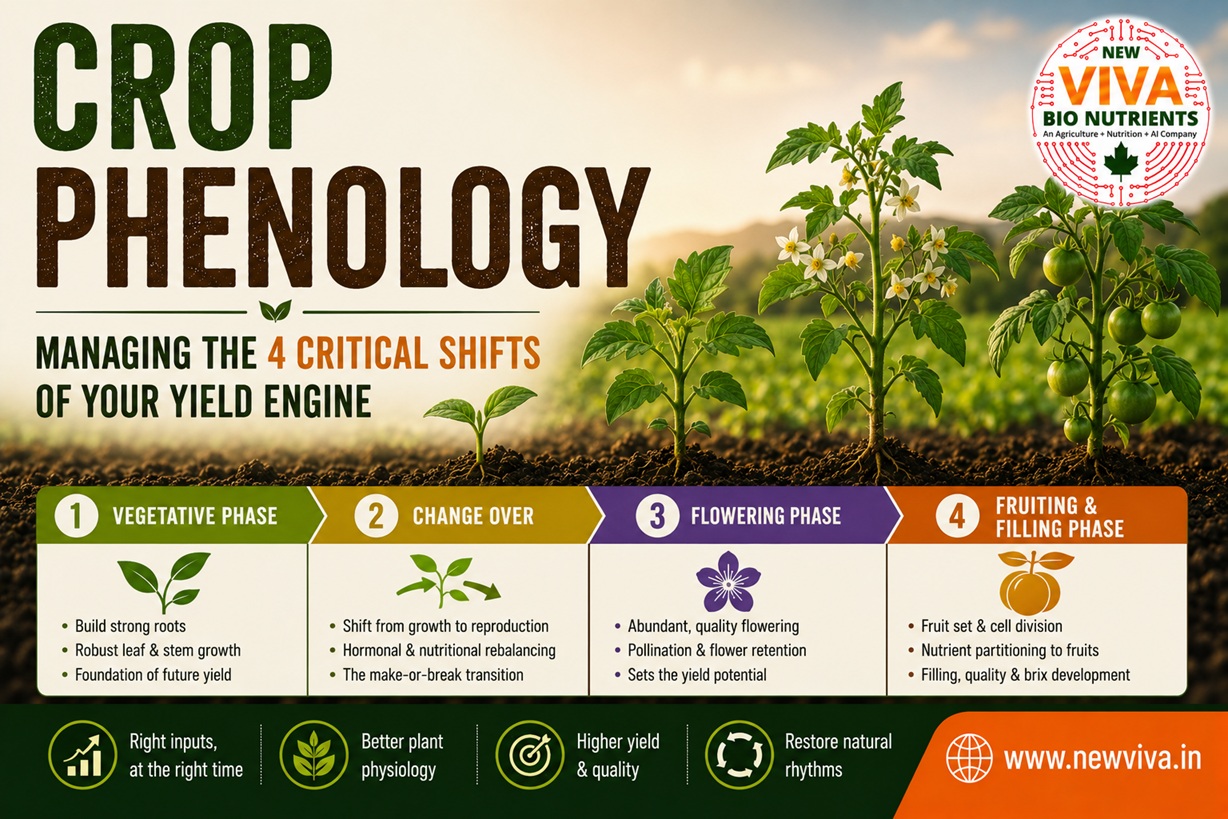
But plants are not like that; they are a noble life form that continuously changes itself. As the crop grows, the different life milestones it passes through are scientifically called "Phenological Phases."
Each time a stage changes, the crop completely alters its internal hormone recipe (Hormone Code) and turns its nutrient requirement upside down. If you give the wrong nutrient during this transition window... the crop's hormone balance breaks, and without setting flowers, without setting fruit, invisibly you will lose half your yield. At the same time, to understand this—it does not mean only the nutrients mentioned here are needed in that season. Other nutrients are also needed but in slightly lesser quantities.
To earn higher profits, you must definitely know these 4 major critical stages of your crop and their nutrient requirements.
Stage 1: The Vegetative Phase
- What happens: This is the crop's childhood and adolescence. During this time, the plant's only goal is to bulk up its body—that is, to build broad solar panel leaves, a thick stem, and a deep root system.
- Nutrients required: This first stage is directly driven by Nitrogen and Calcium. Calcium builds the brick walls of plant cells; Nitrogen creates the leaf's green engine (Chlorophyll) and accelerates photosynthesis.
- Danger: If calcium is low in the soil here, the plant grows tall but is weak inside. This is an invitation card you are placing for root rot diseases and sap-sucking pests!
Stage 2: The Changeover / Transition
- What happens: This is the most important, yet most forgotten, season in all of agriculture! This is the strange time when your plant or tree's DNA decides how many flowers it should bloom and how many fruits it can bear on its body. At this time, the plant shifts from the growth hormone (Auxins) to the flowering hormone (Cytokinins).
- Nutrients required: To make this massive hormone shift, the crop needs an incredible amount of Phosphorus and Manganese. Phosphorus provides the battery energy (ATP) for this transition; Manganese turns on the flowering switch.
- The Himalayan mistake farmers make: Wanting the plant to turn a nice "dark green," many farmers go and pour Urea (Nitrogen) at this time. This is a huge disaster! Excess Nitrogen prevents the plant from flowering and sends it back into the vegetative loop, forcing it to grow only leaves again. Then flowers won't set properly, and yield will be halved.
Stage 3: The Flowering Phase
- What happens: The stage where the crop opens its reproductive organs. Pollen must be vigorous, cell division must happen at lightning speed, and the flowers that bloom must strongly attach to the branch without dropping from the stalk.
- Nutrients required: This stage is completely governed by Boron and Calcium. Think of Boron as a lorry driver and Calcium as cement. Boron correctly pulls Calcium and deposits it at the flowering tips, making the stalks as strong as iron. Extending the pollen tube and helping 100% of flowers convert to fruit is also Boron's job.
- Danger: If Boron or Calcium is locked up in the soil... with just a light wind or rain, flowers will drop in bunches (Flower Drop). Even if a lakh of flowers bloom on your tree, not a single fruit will remain!
Stage 4: The Fruiting & Filling Phase
- What happens: The leaf factory is ready, flowers have turned into fruits. Now, weight must be brought to the fruits. All the high-quality complex sugars (Brix) cooked by the leaves must be transported rapidly to the fruits, increasing their density (Specific gravity) and weight.
- Nutrients required: This final stage is totally controlled by Potassium (Potash). Potassium works like a railway track inside the plant's body. It loads the sugar packets from the leaves and drops them directly into the mango, banana, or coconut. Along with this, Magnesium is also needed to keep the leaves from aging.
- Danger: If Potassium is low during this time... your fruits will be small, weightless, and inside, watery and tasteless. They will spoil quickly when exported.
What We Must Understand:
Stop applying fertilizer blindly by looking at a calendar. Stand in your field, look at the crop, and ask: "What stage is my crop in today? What tool does its hormone engine need right now?"
When you give nutrients according to the crop's phenology, you are doing business in sync with nature! In the next post, we will clearly look at the growth stages in paddy.
We'll talk more.
Ravishankar Karuppiah
New ViVa Bio Nutrients
www.newviva.in
934 204 9144