VV-030: The Ghost in the Soil — How Glyphosate Secretly Starves Your Soil
For decades, farmers have been told a convenient lie: "Glyphosate breaks down within a few days of hitting the soil, decomposing very quickly" — they say.
But if you observe your field keenly, the truth appears different. You will see crops that sprout after herbicide application suddenly turn pale and stunted. Or, root rot disease suddenly appears and ruins the entire yield. Or, no matter how many bags of NPK fertilizers you pour, the nutrient deficiency in the crops never resolves — this is a very distressing matter.
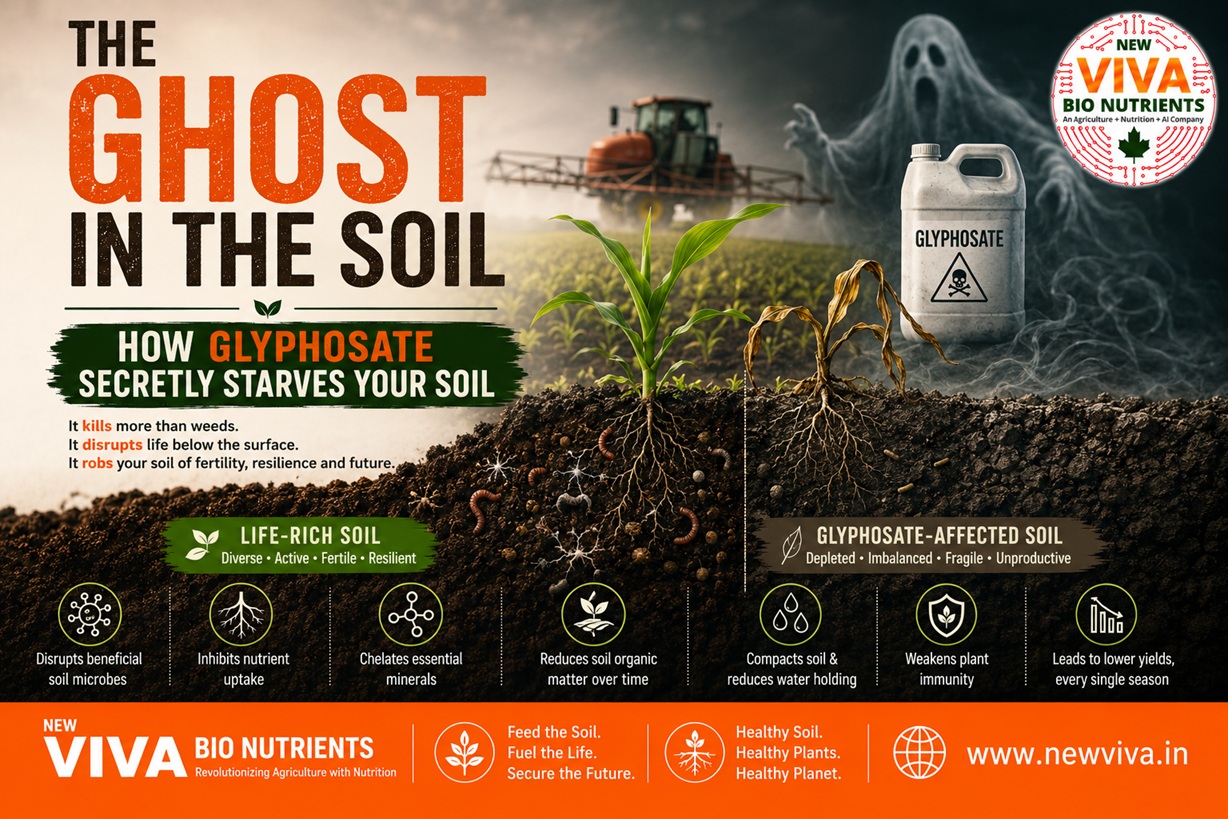
To understand why this happens, we must turn to the research of Dr. Dan Huber, a renowned plant pathology professor at Purdue University. His science clearly shows us that glyphosate is not just an ordinary herbicide — it is a deadly weapon that deforms the entire biological system of the soil.
The reason I am saying this here is that we need to understand fundamentally how an herbicide works. If we just pass it off as "it is a poison," there will be many gaps in how we restore a field that has been sprayed. Only when we understand how it affects crop growth when planting on herbicide-sprayed land can we move toward the right solution. That is why I am writing this here.
The Hidden Scientific Monster: Glyphosate is a Deadly Chelate!
Chemical companies always tell a simple story — that glyphosate only blocks the shikimate pathway in plants, stopping amino acid production and killing weeds. (This is a trait found only in microorganisms and plants — this shikimate pathway is crucial for producing amino acids.)
But Dr. Huber tears off this mask and shows the real face: Glyphosate is a very powerful metal chelator. Here, understand chelator as "a substance that tightly holds onto something."
The truth is — glyphosate was originally discovered to scrape and clean salt deposits from iron pipes in factories. When sprayed on the land, it does the same thing! Once it enters the soil, it acts like a magnet, pulling and locking away the most critical micronutrients that crops need.
- It captures and immobilizes manganese, iron, zinc, copper, magnesium, and calcium in the soil.
- Because these nutrients are unavailable, the entire enzyme function of the plants shuts down.
Here is a crucial point — if manganese is unavailable, plants cannot build their natural disease resistance. Dr. Huber says very clearly: Glyphosate does not directly kill weeds; it completely destroys the crop's immune system. Only after that do harmful fungi like Fusarium and Pythium from the soil come and easily attack and destroy the crop.
Here lies a great cruelty — the main crops we plant next in that same soil also get caught in this same nutrient lock-out web. You might have noticed a slight yellowing when planting on herbicide-sprayed land — that is the danger signal from the crop! Because glyphosate has imprisoned manganese, the crop is starving from deficiency without getting that nutrient.
Shall we go a little deeper? One important issue in our society today — infertility. Glyphosate is also a major cause of this. Why? Because the herbicide holds onto the micronutrients in our soil and does not give them to the crop. Since the crop does not get those nutrients fully, we also do not get them fully. We must understand that this is also a major reason for 99% of our non-communicable diseases.
For example, manganese — this is a nutrient that should be abundant in bananas. But today, no one does banana farming without herbicide. Manganese is generally a key nutrient needed for flowering. It is the same for all life — it is the same for us too. But now, in our bananas, it is mostly absent.
Similarly, think about iron — anemia, weakness — why have these increased today? There is a big problem with the crop getting full iron nutrition on herbicide-sprayed lands. If the crop does not get it, we do not get it either. All we get are non-communicable diseases.
The Deception of Decomposition Time: The Poison That Persists in Soil!
Now the question — how long does this chemical demon stay in our soil?
A common estimate says half of it decomposes within 30 to 60 days. But independent global research says otherwise. Depending on soil conditions, glyphosate's half-life ranges from 3 days to 197 days! That means it takes nearly a year for a single application of herbicide to completely leave the soil.
Now think — what happens when you spray herbicide two or three times a year on dry land devoid of microorganisms? The rate at which it accumulates in the soil exceeds the rate at which it decomposes. Over time, your soil becomes a barren land where all essential micronutrients are locked up in chemical prison. This is what we must understand.
The Redemption of Regenerative Agriculture: This is the Only Way!
To escape this dangerous chain trap, Regenerative Agriculture is the only way! A chemical lock cannot be opened by another chemical — this is an important lesson.
To recover soil from years of glyphosate damage, we must use both immediate crop protection and long-term biological recovery simultaneously. That is a holistic approach.
1. Filling the gap with pre-chelated micronutrients:
It takes time for soil microbes to multiply and break down old toxins. If we wait idly until then, crop yields will be severely affected. To fill this gap, we must directly supply micronutrients like manganese, zinc, and iron that are pre-chelated with humic or fulvic acids. Because these are already bound to natural carbon molecules, the glyphosate residues in the soil cannot lock them up. Until the soil heals, this acts like an emergency bridge, delivering essential nutrients directly to the roots.
2. Mobilizing the microbial army:
Glyphosate is a deadly antibiotic that destroys good bacteria and fungi in the soil. Through diverse microbial inoculants, liquid humates, and keeping living roots in the ground year-round, we can rebuild a microbial population that rapidly breaks down the accumulated glyphosate and AMPA toxins in the soil.
3. Restoring the fungal network:
Glyphosate completely severs the noble fungal highways like mycorrhizae beneath the soil. Through no-till practices, diverse cover crops, and proper mulching, when we rebuild this fungal network, the soil regains its self-power, breaks the chemical barriers, and begins to absorb nutrients on its own.
Among these, #1 — providing pre-chelated nutrients — is the most important. None of the current agricultural practices fully understand this. This is possible only in the Regenerative Agriculture system.
The truth is very simple: stop treating soil like a lifeless dustbin. All the chemical shortcuts we sought in the past have locked away our soil's original wealth. Now, it is time to unlock it with regenerative science!
We will talk more!
Ravishankar Karuppiah
New ViVa Bio Nutrients
www.newviva.in
934 204 9144