எங்கள் வாட்ஸ்அப் குழுவில் இணைய (Join our WhatsApp group) - https://chat.whatsapp.com/DtRfcPrnZykIfmavZU6kj0
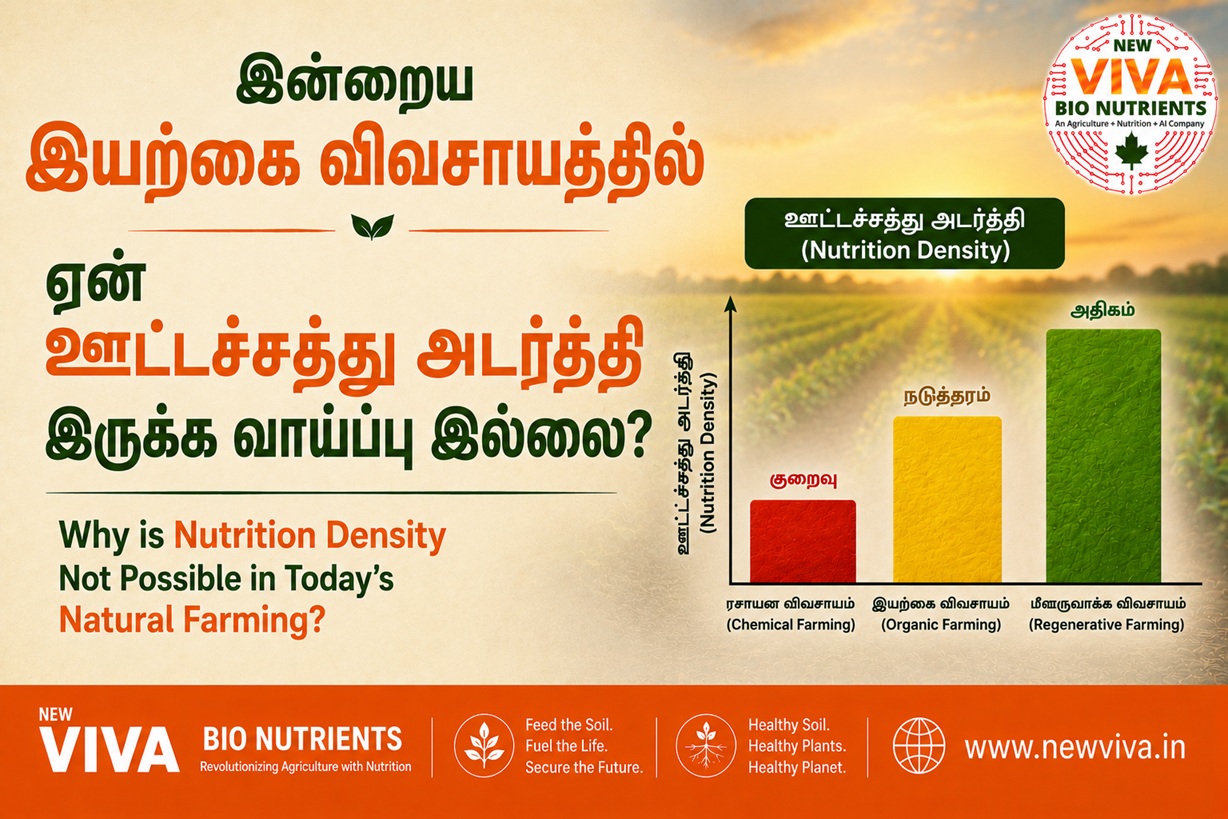
VV-036: Why there is no possibility of nutritional density in today's natural farming?
Direct Answer: Natural farming often fails to produce nutrient-dense food because tillage and bacteria-only liquid fertilizers (like Panchakavya, Jeevamrutham) destroy mycorrhizal fungi — the only pathway that delivers immobile micronutrients like zinc, selenium, and copper to crop roots. Without fungi, crops grow green and fast on nitrogen but stay micronutrient-deficient.
In our previous post, we saw that nutritional deficiency is the primary cause of non-communicable diseases in humans. But an important question arises there:
Even after a natural farmer stops using chemical fertilizers, why do the foods he produces still lack micronutrients like Zinc, Selenium, and Copper?
The answer lies in the soil's biology, specifically in the Fungi to Bacteria Ratio. Moreover, there is a huge flaw in the natural farming methods we follow: excessive tillage and the use of liquid fertilizers that are dominated solely by bacteria!
1. The Highway for Micronutrients: Fungi!
The danger can only be understood if we grasp how nutrients move from the soil to the crop.
Primary nutrients like Nitrogen easily dissolve in soil water and reach the roots. However, the micronutrients essential for the human body—Zinc, Phosphorus, Copper, Iron, Selenium—are not easily water-soluble; they are present only in small quantities and remain immobile in the soil. The crop root can absorb them only if it directly reaches and touches those nutrient particles.
This is where Mycorrhizal Fungi come into play. Fungi create billions of microscopic, nerve-like networks called Hyphae beneath the soil. These fungal networks penetrate to depths 100 times greater than plant roots can reach.
- Fungi release specialized natural acids that dissolve micronutrients locked in rocks.
- They carry those micronutrients to the root tips and, in return, receive carbon sugars from the plant.
If the fungal network is absent in the soil, the plant cannot even access the micronutrients!
2. How does Tillage destroy fungi and boost bacteria?
Why are fungi completely destroyed in today's farmlands? Continuous tillage!
When a farmer tills the land with a tractor or rotavator, three things happen:
- Fungal networks are shredded: It takes many months for fungi to build their network in the soil. A single tillage cuts and destroys those delicate fungal threads into pieces.
- Oxygen surge & bacterial bloom: When the land is tilled, a large amount of oxygen enters the soil. In this oxygen-rich environment, bacteria multiply rapidly and consume all the simple carbon available in the soil.
- Nitrogen-driven growth: In bacteria-dominated soil, Nitrogen is released rapidly. The crop absorbs this Nitrogen and grows green and fast—but since the fungi have been destroyed, the crop never gets the micronutrients needed to match its growth!
3. The Blind Spot of Natural Farming: Bacterial Liquid Fertilizers!
Today's natural and organic farming methods recommend using liquid fertilizers like Jeevamrutham, Waste Decomposer, and cow dung solutions instead of chemical fertilizers.
While these are excellent for enlivening the soil, farmers must understand what is actually inside those barrels:
- What is in the barrel?: When cow dung, urine, groundnut cake, and jaggery are mixed with water and fermented for 3 to 7 days, only rapidly multiplying aerobic bacteria grow there.
- What is not in the barrel?: You cannot grow Mycorrhizal fungi by putting water and sugar into a plastic barrel! Fungi require undisturbed soil, woody debris, and living plant roots.
If a farmer continues to till the land while only pouring bacterial solutions like Jeevamrutham, the soil gets trapped in a Bacterial Loop. The crop will grow green, but the fungal system that mines deep micronutrients needed for the human body will never develop there!
How to produce nutritionally dense food?
To produce truly nutritious food that can heal human metabolism, we must shift from bacterial farming to fungal stewardship:
- Practice minimal tillage: Do not plow and destroy the delicate fungal networks developing in the soil.
- Maintain living roots year-round: Fungi need living roots to survive. Grow diverse cover crops between main crops.
- Feed the fungi: Instead of relying solely on sugar-water/bacterial fertilizers, apply decomposed wood chips, straw, biochar, and fungal-rich composted manure as mulch on the soil.
Truly nutritious food cannot be produced inside a plastic barrel—it can only be produced in healthy, low-tillage, fungi-rich soil!
Regenerative farming, with scientific support, establishes exactly this framework.
We'll talk more.
Ravishankar Karuppiah
New ViVa Bio Nutrients
www.newviva.in
934 204 9144