VV-031: Seed Treatment - The Best, Most Economical Key of Regenerative Agriculture
This is Aadi month. The month of sowing seeds.
Most farmers will be buying maximum quantities of fertilizers and inputs this month. But there is a low-cost alternative to this.
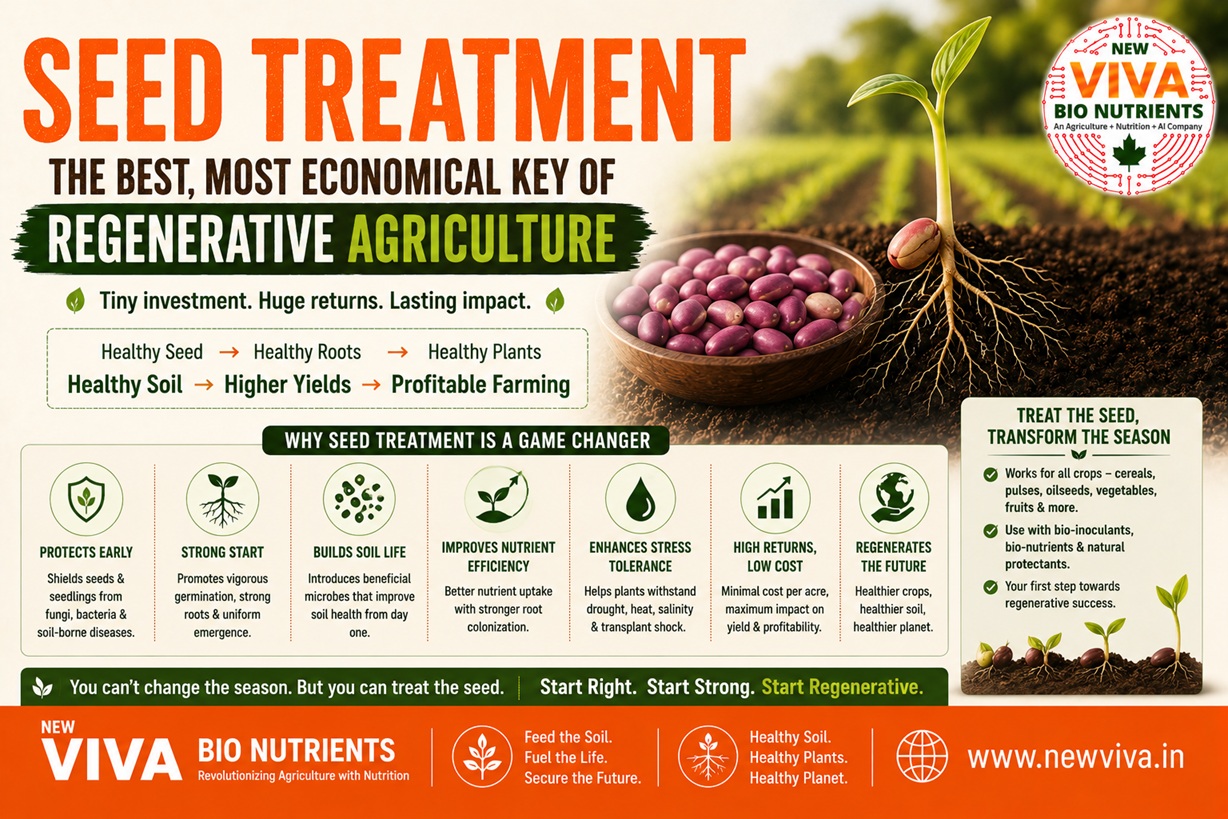
If you want to transition your farm to Regenerative Agriculture without high expenses, the best way that gives the highest ROI (Return on Investment) at the lowest cost is: Biological Seed Treatment.
As John Kempf and leading regenerative agriculture experts say, seed treatment is the one moment in a crop's entire lifetime that can create an incredible transformation at the lowest cost. When we give the seed the nutrients and microbes it naturally needs right at the time of germination, we can determine the success of that crop's disease resistance, root system, and final yield even before it pushes through the soil.
How Does the Seed Microbiome Function?
To understand why biological seed treatment is so powerful, we need to closely examine the Seed Microbiome and the extraordinary biological phenomenon discovered by Dr. James White called the Rhizophagy Cycle.
Every viable seed is not just a tablet containing genes; it is a world unto itself. Within the seed coat, a "native microbial consortium" (bacteria and fungi) is naturally stored. When a seed begins to germinate in moist soil, it releases some simple sugars and carbohydrates from its young root tip. This does not happen in vain—it is a signal given by the plant to awaken the microbes around the seed and attract native microbes in the soil!
Here is the Rhizophagy Cycle that happens next:
- The tip of the young root "ingests" these living microbes whole.
- Once inside the root cells, the plant dissolves the outer cell walls of these microbes and absorbs the vital nutrients contained within them (such as natural nitrogen, zinc, phosphorus, etc.).
- But the plant does not kill those microbes! Instead, it forms root hairs and gently releases the surviving microbes back into the soil.
- Once back in the soil, those microbes rebuild their outer cell walls, collect nutrients from the soil into themselves, and the cycle repeats.
Chemical Disaster: The harmful chemical fungicides, insecticides, and highly saline chemical fertilizers that we apply on seeds in modern agriculture completely destroy this incredible native microbial consortium. By killing the seed microbiome and disabling the Rhizophagy Cycle, that young crop germinates as a weak plant that becomes entirely dependent on chemical life-support aids.
Step-by-Step Protocol for an Economical Biological Seed Treatment Method
The main goal of regenerative seed treatment is to give easily absorbable nutrients and biodiverse microbes to that small zone around the germinating seed, like a "traveler's packed meal."
Here are the steps to prepare this biological mixture yourself at a very low cost:
Step 1: Biological Inoculants (Microbial Army)
- What to use: Quality Mycorrhiza (AMF), Azospirillum/Azotobacter, Phosphobacteria, Bacillus microbes, Pseudomonas, and Vermi-wash (Worm casting extract).
- Reason: This multiplies the seed microbiome manifold as soon as the root emerges and kickstarts the Rhizophagy Cycle immediately.
Step 2: Biological Catalysts (Microbial Energy)
- What to use: Liquid Humic and Fulvic acids.
- Reason: Humates act as a natural carbon catalyst. They chelate the micronutrients we add, feed the microbes, and stimulate rapid root elongation.
Step 3: Pre-Chelated Micronutrients (Packed Lunch)
- What to use: A very small quantity of Seaweed extract (Kelp), and easily absorbable micronutrients (primarily Manganese, Zinc, Iron, Boron, Sulfur, Copper, and a very small amount of Molybdenum).
- Reason: Nutrients like Manganese and Zinc are the "spark plugs" that drive the plant's early-stage enzyme functions and photosynthetic engine. Seaweed provides natural hormones for root development.
Step 4: Adhesive and Food Source
- What to use: Raw cane sugar or jaggery solution, or Molasses.
- Reason: This acts as a natural adhesive to uniformly stick the powdered microbes we add onto the seed. At the same time, it provides immediate sugar energy for the microbes waking up from dormancy.
Procedure:
- Prepare the liquid mixture: Take a small amount of water in a container and add Humic/Fulvic acid, seaweed solution, raw cane sugar/jaggery solution, and micronutrients, and dissolve them well without any lumps.
- Inoculation: Gently add and mix the bio-inoculants we have kept ready into this solution mixture.
- Apply on seeds: Spread the seeds on a clean tarpaulin or in a seed treating drum, spray the prepared mixture over them, and tumble well so that it coats all seeds evenly.
- Dry in shade: Spread the treated seeds in a cool, shaded place and dry them well. After that, they can be used for sowing. Treated seeds should never be dried in direct sunlight; the UV rays in sunlight will kill the living microbes.
Why Is This the Right Way? (Economic and Agricultural Reality)
Why should we stop the expensive chemical seed treatments we buy and switch to this biological method?
- Incredible Cost Reduction: Only a few grams or milliliters of nutrients are enough to treat the seeds needed for one acre. Instead of broadcasting fertilizers across the entire field, we are precisely placing food in that millimeter-sized zone where the root emerges. This is a seed that can create the biggest transformation with the lowest investment in agriculture.
- Dense Root Architecture: Seeds treated with biological seed treatment develop incredible, branched root systems. Thick soil sheaths (Rhizosheaths) made of microbial mucilage form around these roots. If the root zone is larger, the crop can easily extract water and hidden nutrients from deeper in the soil even during drought conditions.
- Natural Disease and Pest Resistance: Because the Rhizophagy Cycle and seed microbiome are operating at full capacity from day one, the crop's cell walls are very strong and its early-stage disease resistance is very high. This naturally prevents seedling rot diseases, root rot, and attacks from sap-sucking pests right from the start.
When we approach the seed not as a lifeless object, but as a living, biodiverse ecosystem, we fully unlock that crop's true genetic potential within its very first hours!
Therefore, whatever the type of farming, let us make seed treatment mandatory.
We will talk more.
Ravishankar Karuppiah
New ViVa Bio Nutrients
www.newviva.in
934 204 9144